Leave Your Message

What Are the Top 10 Types of Office Cabinets?

An office can look organized at 9 a.m. and feel crowded by noon. Paper stacks grow, shared supplies migrate, and confidential files need a secure place. The right Office Cabinet can make daily work smoother without consuming valuable floor space. Yet choosing one is rarely just about appearance.

Office-storage consultant Lena Hart puts it this way: “A useful cabinet fits the work, the room, and the habits of the people using it.” This guide explores ten common types, from lateral and vertical file cabinets to mobile pedestals, storage credenzas, lockers, bookcases, and fire-resistant models. Each serves a different purpose. Some keep folders close to a desk; others store shared equipment, binders, or personal belongings. Small details matter, too: drawer depth, lock placement, shelf adjustability, and whether doors can open fully beside a walkway.

Measure first. Then consider what staff reach for most, how much storage they actually need, and whether the cabinet must move or lock. A compact pedestal may suit one workstation, while a broad credenza can anchor a meeting room. Looks matter, but they can distract from fit and access. Not always obvious. A cabinet that holds more may also make frequently used items harder to find. This overview compares practical strengths and trade-offs, so readers can identify options that suit their room, workflow, and budget—with room to reconsider when real use differs from the plan.
What Are the Top 10 Types of Office Cabinets?

Classify Office Cabinets by Function, Placement, and Storage Format

Office cabinets are easier to choose when classified by function, location, and storage format. For active files, vertical cabinets suit narrow walls, while lateral cabinets offer wider drawers for shared records. Mobile pedestals tuck beneath desks; credenzas keep supplies close to meeting tables. Overhead units free floor space, but heavy items should stay low. Small detail, big difference.

Placement shapes the next choices. Lockers work near entrances in shared offices, while wardrobes fit private rooms that need coat storage. Supply cabinets belong near print or work areas; archive cabinets suit low-traffic rooms. The U.S. EPA’s 2018 materials report recorded a 68.2% recycling rate for paper and paperboard across the U.S. waste stream—not an office-only figure. Still, it supports planning separate, labeled space for reusable paper and confidential files. Storage format matters, too: open shelves speed access, closed doors reduce visual clutter, and drawers protect folders from dust. In practice, teams often misjudge future volume. Measure the actual binders and boxes before ordering; tidy plans can age badly.
Compare 10 Types: File, Lateral, Mobile, Tambour, and Specialty Cabinets

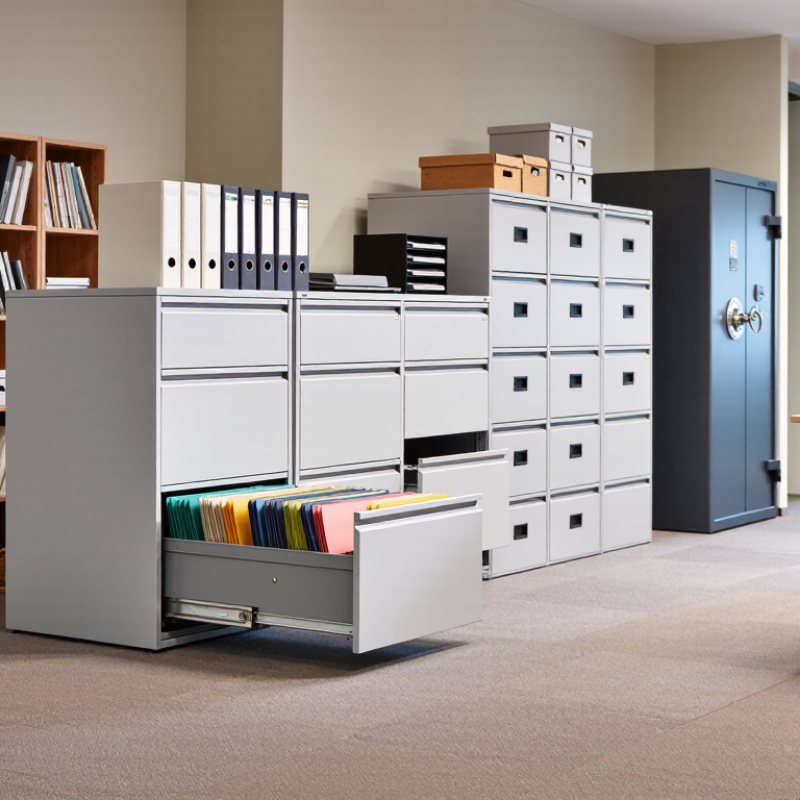
Vertical file cabinets use narrow footprints and deep drawers, making them useful beside desks with limited floor space. Lateral cabinets are wider, so folders sit side by side and are easier to scan. Mobile cabinets add casters for flexible work areas, but check that brakes hold on smooth floors. Tambour cabinets have sliding doors that tuck away, keeping narrow walkways clear. Pedestal cabinets fit beneath desks and keep frequently used papers close. Overhead cabinets save floor space, though their contents should remain within comfortable reach.

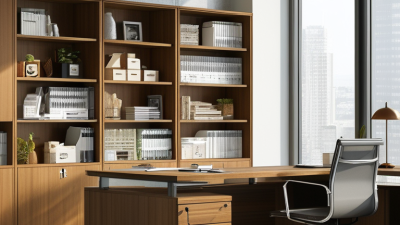
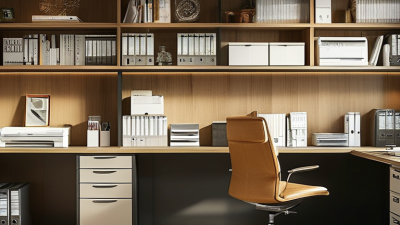
Credenzas combine closed storage with a broad work surface for printers or supplies. Bookcase-style cabinets display binders and reference books, but open shelves collect dust. Wardrobe cabinets hold coats and personal items in shared offices. Specialty cabinets can be designed for plans, printer supplies, or other specific materials. These ten types solve different problems; the best choice depends on what must be stored, how often it is accessed, and the room’s layout. A cabinet that looks right on paper may still block a chair.

Tips: Measure the cabinet, door swing, and walking path before buying. For heavy files, check drawer capacity and anti-tip features. Label shelves clearly. Small details matter. Don’t assume one large cabinet is always more efficient; dividing supplies by use can make daily tasks easier.

Check EPA Panel Limits: 0.05 ppm Plywood, 0.09 Particleboard, 0.11–0.13 MDF

Office cabinets may look similar from the outside, but their panel cores can differ. A storage tower, lateral file cabinet, credenza, or wall cabinet may use plywood, particleboard, or MDF behind its finish. Under US EPA TSCA Title VI standards, the formaldehyde emission limits are 0.05 ppm for hardwood plywood, 0.09 ppm for particleboard, and 0.11 ppm for MDF. Thin MDF has a 0.13 ppm limit. These are panel-emission limits, not guarantees of a room’s indoor-air level. That distinction matters.

When comparing cabinet types, check the product label or documentation for the regulated panel materials and compliance status. A smooth laminate surface does not reveal what lies beneath it. The figures refer to formaldehyde emissions measured using prescribed test methods, not a simple reading from a home monitor. Look closely. If a cabinet listing names only the finish, ask what its core panels are made from. I would not assume every component uses the same material; mixed construction is common, and listings can be vague. A little uncertainty remains when specifications are incomplete, so verify before buying.

Assess Storage-Unit Durability Under ANSI/BIFMA X5.9-2019

Office cabinets may look sturdy, but appearance cannot show how drawers behave after years of use. ANSI/BIFMA X5.9-2019 provides test methods for evaluating office storage units under defined conditions. Depending on the cabinet’s design, testing can examine structural strength, stability, and the repeated operation of components such as drawers and doors.

That matters. A loaded drawer that sticks, or a tall cabinet that shifts when opened, can disrupt daily work.

When comparing lateral files, pedestals, bookcases, or storage cupboards, check whether test results apply to the exact model and configuration. Shelf spacing, drawer size, and specified loads can affect performance. Ask for documentation that identifies the standard and the unit tested; vague claims are difficult to verify.

Still, a laboratory result is not a promise of a particular service life. Real offices vary: floors may be uneven, users may overload shelves, and drawers may be pulled roughly. I would treat the standard as useful evidence, not a complete buying decision. Also inspect construction details, such as smooth drawer travel, secure shelf supports, and clear load guidance.

One detail is easy to miss: the test conditions.

Choose Cabinet Capacity, Security, and Layout for Workplace Needs

Office cabinets do more than hide paperwork. The right choice depends on what staff store, how often they need it, and where it fits.

Common options include lateral and vertical file cabinets, mobile pedestals, wardrobes, bookcases, credenzas, utility cabinets, lockers, tambour-door cabinets, and fire-resistant models.

Each serves a different purpose. A mobile pedestal can sit beside a desk, while a wardrobe needs room for doors and hanging coats.

Estimate capacity from actual items, not a guess. Count binders, measure bulky equipment, and leave some space for future growth.

For sensitive records, check the lock type and who needs access; a lock is useful only when key control is managed. Consider the room layout, too. Deep cabinets can block walkways, and open drawers may collide with chairs. Measure doorways and elevator access before ordering.

I have seen neat floor plans miss that detail. It is easy to overlook.

Tips

Label shelves clearly, place frequently used files between waist and eye level, and anchor tall cabinets when appropriate. Small details matter. Review the arrangement after a few weeks; staff may use it differently than expected.