10 Best Standing Desks for Home and Office in 2026
A standing desk can change the feel of a workday, but the right choice depends on more than a motor and a polished desktop. At home, a compact frame may need to fit between a bookcase and a wall. In an office, stability matters when a large monitor, keyboard, and notes share the same surface. Small details count.
This guide to the 10 Best Standing Desks for Home and Office in 2026 considers practical factors: height range, desktop size, lifting capacity, adjustment controls, stability, assembly, and warranty coverage. These are useful comparison points, not guarantees that a desk will suit every person or room. Check each model’s current specifications, since configurations and prices can change. Also consider how you actually work: frequent height changes may make quiet, responsive controls more valuable than extra storage.
No desk is perfect. A wider top can feel generous, yet crowd a small room; a lower price may mean fewer adjustment features. Those trade-offs deserve a closer look. This selection is intended to help readers compare options clearly, rather than declare one universal winner. Measure your space, note your preferred sitting and standing heights, and think about what your setup weighs. Then use the picks as a starting point—not a substitute for checking fit, return terms, and manufacturer details. Small differences matter. A desk that looks ideal online can feel different beside a real window, cable outlet, or chair. That part is easy to overlook.
Standing Desk Fundamentals: Types, Features, and 2026 Selection Criteria
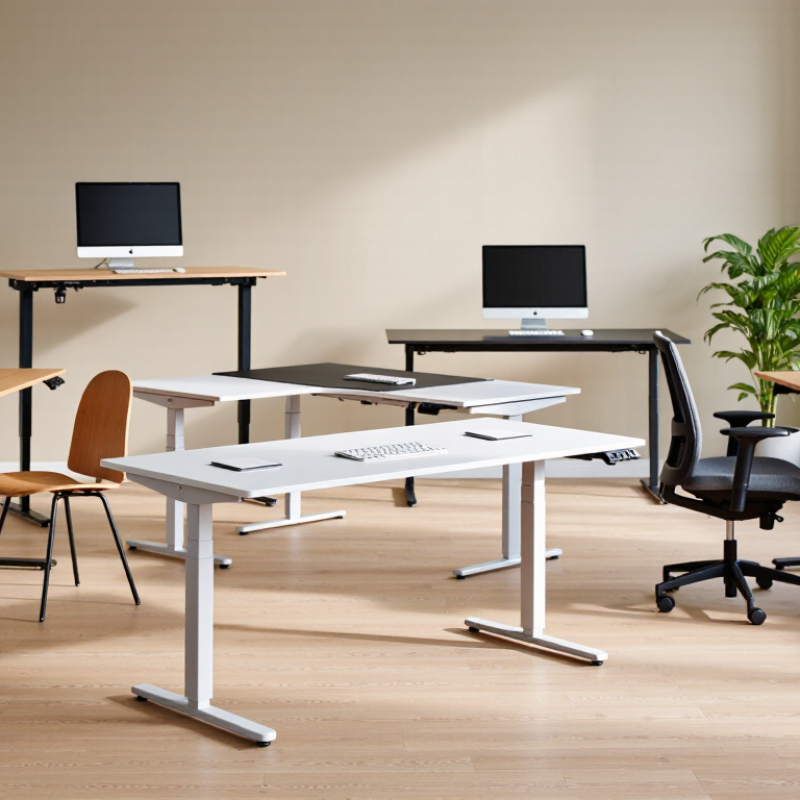
Standing desks generally fall into three types: fixed-height risers, manually adjusted desks, and electric models. Risers sit on an existing desk and suit limited spaces, while full desks offer more adjustment and room for monitors. Electric models make frequent changes easier, but motors add cost and another part to maintain. Small details matter.
Check the adjustment range against your seated elbow height and your standing posture. Your shoulders should stay relaxed, with wrists near level as you type. Compare tabletop depth, frame stability at maximum height, lifting capacity, controls, and cable routing.
A 2018 Cochrane review found sit-stand desks reduced workplace sitting by about 100 minutes per workday in the short term; the evidence was low-certainty, and long-term effects remained unclear.
A height-adjustable desk helps change posture, but it does not replace movement breaks.
For a practical 2026 shortlist, measure your room, monitor footprint, and floor clearance before comparing features. ANSI/BIFMA X5.5-2021 offers a relevant safety and performance reference for desk products; meeting a standard does not guarantee a good fit for every user.
Cable routing is easy to overlook until a monitor cord pulls taut at full height. Consider noise, assembly, warranty terms, and the desk’s lowest setting, too. A memory preset is convenient, but careful measurement matters more.
Ergonomic Fit: Set Desk Height for a Neutral Standing Posture
A height-adjustable desk only helps when it fits your body. Stand with relaxed shoulders, elbows near your sides, and forearms roughly parallel to the floor. OSHA’s computer workstation guidance recommends this neutral arm position to reduce awkward reaching. Keep wrists straight while typing, and place the screen so you can look ahead without tipping your chin upward. Small adjustments matter: a few centimeters can change how your shoulders feel by lunchtime.
To set the desk, stand in your usual shoes and raise the surface until your hands rest comfortably over the keyboard. Keep your knees soft, not locked, and your feet flat. If your wrists bend upward, lower the desk slightly; if your shoulders lift, it may be too high. The Cochrane review of workplace sitting interventions reported that sit-stand desks reduced sitting by about 100 minutes per workday in short-term studies, though the evidence was rated low quality. More standing is not automatically better. Movement still matters.
I still catch myself leaning on the desk when tired. That is a useful cue, not a posture failure. Try alternating positions, and adjust again when aches or pressure appear. A footrest can help shift weight, but it cannot fix a poorly set desk.
Compare 10 Desks by Height Range, Load Capacity, Stability, and Controls
A useful comparison of ten standing desks starts with fit, not finish. Record each desk’s lowest and highest working heights, then compare them with your seated elbow and standing elbow positions. A wide range is not automatically better if the controls cannot reach it comfortably. Check rated load against the combined weight of the desktop equipment, monitor arms, and accessories. Leave some margin; maximum capacity is not a target.
Stability deserves a hands-on check. Raise each desk to standing height, type for a minute, and watch the monitor and desktop edges. The ANSI/BIFMA X5.5 standard offers a professional benchmark for desk and table safety and durability, but real-world wobble still matters. Compare control layouts, preset buttons, display readability, and obstruction response. Small details matter. A smooth keypad can be easier to use than a crowded panel, especially when changing height mid-task.
Evidence supports changing posture, not standing all day. A 2018 Cochrane review found sit-stand desks reduced workplace sitting by about 100 minutes per workday in the short term, but rated the evidence as low quality. One caveat: published specifications rarely show how a desk feels at full height with a heavy monitor attached. Test that yourself when possible. The best choice balances usable height, realistic load, steady typing, and controls you will actually use.
10 Standing Desks for Home and Office: Specification Comparison
Compare adjustment travel and rated lifting capacity across ten anonymized desk examples. Figures represent published specification examples; exact values may vary by configuration. This is not a stability test or product ranking.
How to read this chart: Height adjustment travel is the difference between each desk’s listed minimum and maximum height. Load capacity is the listed maximum rating, not a measure of stability. Stability depends on factors such as frame design, desk height, floor conditions, and load placement; control features, including memory presets and keypad type, vary by configuration.
Apply ANSI/BIFMA X5.5-2021 Safety and Performance Test Criteria
A standing desk should be judged by more than its height range. ANSI/BIFMA X5.5-2021 sets performance criteria for desk and table products, including tests addressing stability, strength, and durability. These checks matter when a desktop carries a monitor, laptop, and a mug near its edge. Ask whether the model has been tested to this standard, and request documentation rather than relying on a vague “heavy-duty” claim. Testing is useful, but it does not guarantee a perfect fit for every room or user. Small details matter.
The evidence for standing all day is less convincing than the marketing often suggests. A 2018 Cochrane review reported that sit-stand desks reduced workplace sitting by about 100 minutes per day in short-term studies, while noting that evidence quality was limited. That is a change in sitting time, not proof of better health for every buyer. In practice, check that the frame stays steady while the desk moves, and that the controls are easy to reach without leaning. I still notice cable drag on some setups; it is easy to overlook during a showroom test. Consider alternating positions, leaving space for a chair, and checking the desk’s test records before choosing a model. Sources: ANSI/BIFMA X5.5-2021; Shrestha et al., Cochrane Database of Systematic Reviews, 2018.
Rank the 10 Best Standing Desks for Home, Office, and Different Budgets
A fair ranking should weigh stability, height range, usable surface, controls, and price—not motor speed alone. For most home offices, 1 is a dual-motor desk with a broad top and steady frame. It suits long workdays and two-monitor setups. 2 is a strong single-motor model for buyers who want reliable adjustment at a lower cost. 3 is a compact electric desk for bedrooms or shared rooms. Measure the space first.
For tighter budgets, 4 is a manual-crank desk: slower to adjust, but simple and often less costly. 5 is an L-shaped desk for corner offices and paperwork-heavy tasks; it needs real floor space. 6 is a sturdy entry-level electric desk with basic controls. 7 is a height-adjustable desk with memory settings, useful when several people share it. Convenience matters. 8 is a heavy-duty model for larger equipment, though its frame may feel oversized in a small room.
Rounding out the ten, 9 is a minimalist desk with a smaller work surface, best for a laptop and a few essentials. 10 is a desktop riser for people keeping an existing table. It costs less, but offers less legroom and adjustment. No setup is perfect. A ranking can guide a shortlist, not replace checking measurements, return terms, and the desk’s stated load capacity. One detail is easy to overlook: a monitor arm, keyboard, and lamp all take space and add weight.